Access restricted
Access restricted
Symposya for Publishers
Your readers finish the interview and move on. Not because the piece was weak — because the format doesn't help them stay. Symposya turns the same interview into something they can navigate, verify, and come back to. Without changing how you report.
The problem
A long-form interview and a press release look the same on a webpage. The depth you put into the reporting is invisible in the way it gets published. Readers sense something is there — but can't reach it.
Subscribers scroll through a 4,000-word interview and walk away with one takeaway — maybe the headline. The nuance, the sourcing, the reasoning behind the argument: gone. The illusion of being informed is not the same as being informed.
"Better journalism" is hard to point to. A dedicated portal where every interview is navigable, every claim is sourced, and every argument is followable — that's concrete. When your subscribers talk about why they pay, that's something they tell other people about.
How it works
You get a dedicated portal at yourpublication.symposya.com. White-labeled, your brand. Your subscribers access it with their existing login — no new account, no friction.
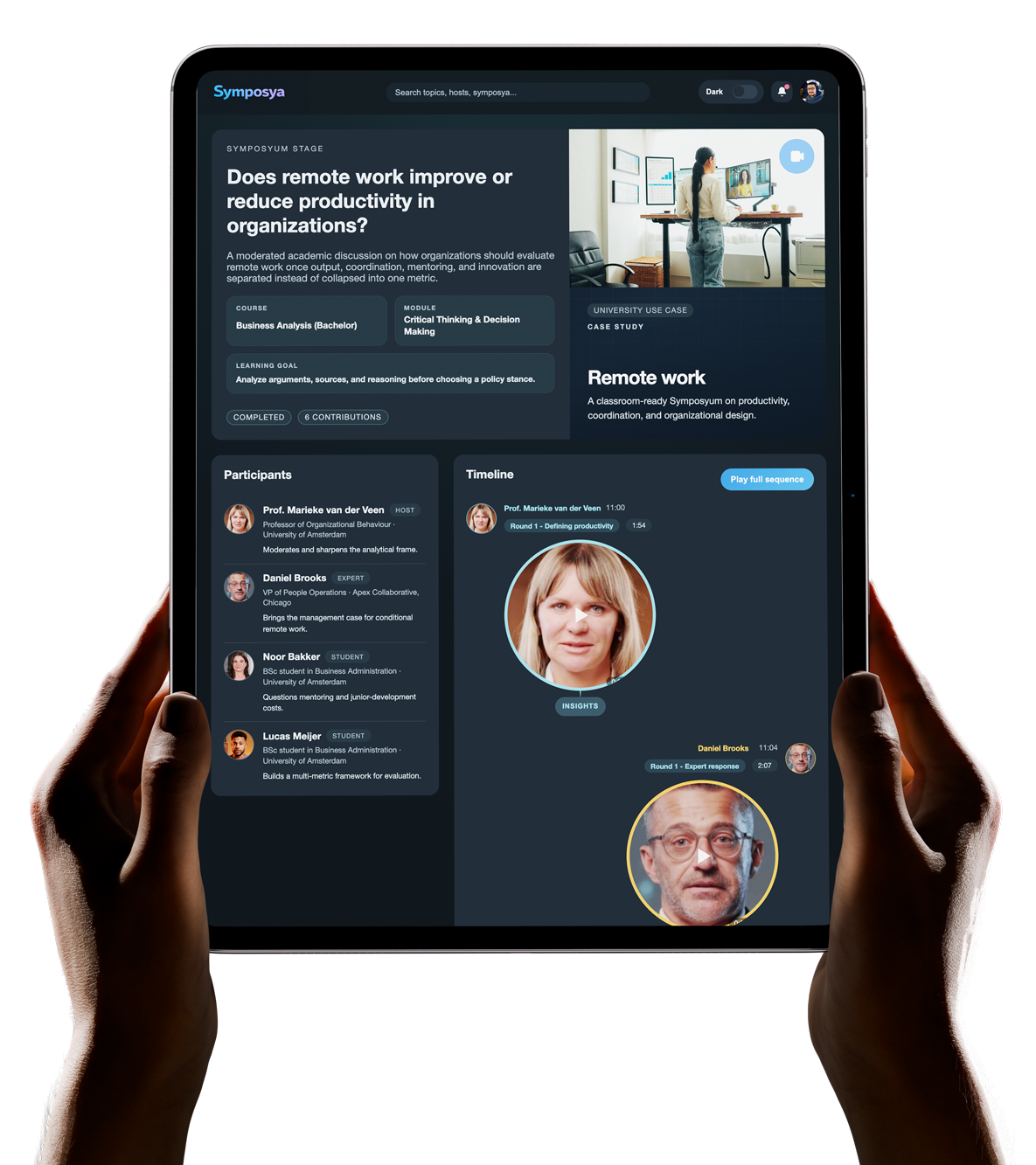
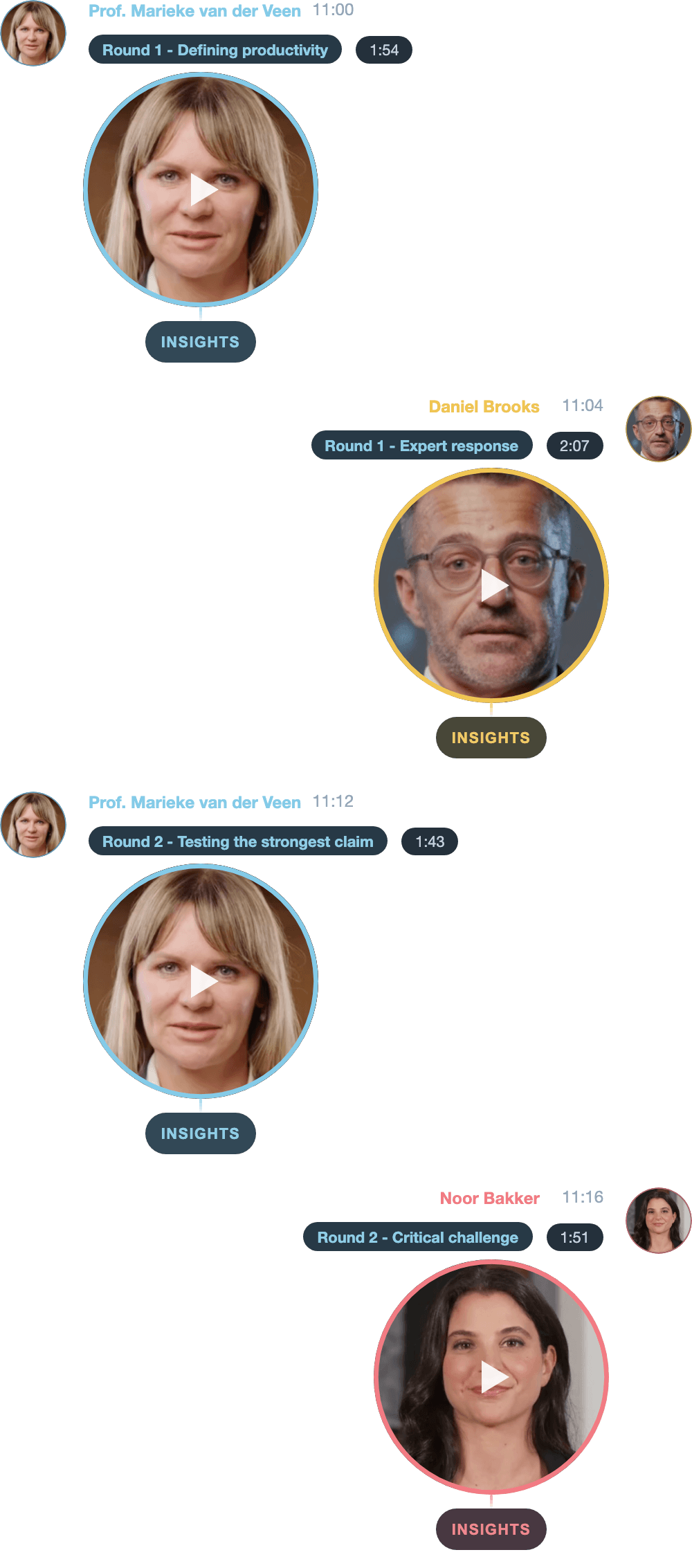
Drop in the transcript, audio file, or video. The platform transforms it into a Symposyum — a structured conversation that unfolds like a chat, where every contribution by the journalist and the interviewee is a node in a navigable timeline. Each node is expandable: key takeaways, key concepts, sources cited in or referenced during the interview. The editor can activate fact-checking on a per-interview basis, or leave it off.
Readers move through the interview on their own terms. They follow the claim that interests them, check the source behind it, read the context, engage with the argument. The same piece does more.
For your newsroom
You don't change how you report. You change how it lands. Symposya is a second surface for journalism you've already produced — structured so readers can finally get what's in it.
For your reader
The format
Three formats
The source determines the format. A written or audio interview becomes a Symposyum Chamber. A video interview becomes a Symposyum Stage. Both are structured, navigable timelines where every contribution is expandable — with key takeaways, sources, and context. And both are also available as a podcast inside the portal.
A written or audio interview becomes a structured conversation that unfolds like a public chat — with defined roles and visible reasoning. Each contribution by the journalist and the interviewee is a node in the timeline, expandable into its full insights panel. The conversation feels fluid while staying organized and traceable.
A video interview becomes an asynchronous structured show. Subscribers watch it as a video — contributions flow like a stream, with documents and external material layered in. Every intervention is expandable with transcript, key points, sources, and context. The same session is also available as a podcast: linear or chapter-by-chapter.
Every Symposyum — Stage or Chamber — is also available as a podcast inside the portal. Subscribers can listen linearly or jump between contributions as chapters. The same depth is there when they want it: each chapter links back to the full expandable node.
Get in touch
We do a 30-minute call where we walk through the format using content from your own archive. No slides, no pitch deck. You leave knowing exactly what Symposya does and whether it fits.